Fiber Network Mechanics: Key Concepts for Biomaterials Research
Contents / 目录
Why Fiber Networks Matter
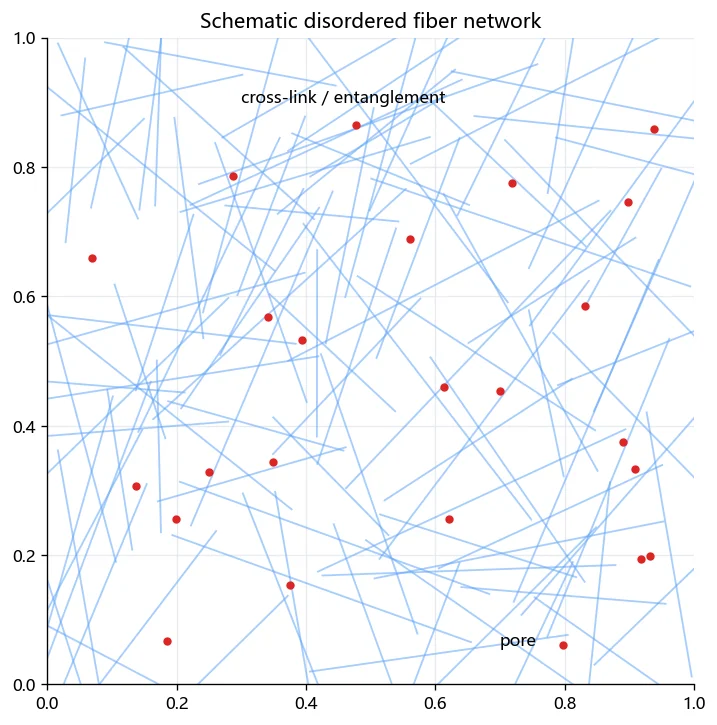
Nature builds structural materials from fibers: collagen in tendons, silk in cocoons, cellulose in plant cell walls. These disordered fiber networks achieve remarkable mechanical properties — high strength-to-weight ratios, strain-stiffening, and toughness — through architecture rather than chemistry alone.
Understanding fiber network mechanics is essential for designing better biomaterials.
Key Mechanical Behaviors
1. Strain-Stiffening
Unlike metals (which soften after yield), fiber networks stiffen as you stretch them. At low strains, fibers reorient and align. At high strains, aligned fibers bear load axially:
import numpy as np
# Conceptual: stress-strain of a fiber network
strain = np.linspace(0, 0.5, 100)
# Low strain: bending-dominated (soft)
# High strain: stretching-dominated (stiff)
stress = 0.1 * strain + 5.0 * strain**3  # simplified
2. Architecture-Property Relationships
| Parameter | Effect on Mechanics |
|---|---|
| ----------- | ------------------- |
| Fiber diameter | Thinner fibers = more flexible network |
| Network density (mg/cm3) | Higher density = higher modulus |
| Crosslink density | More crosslinks = stiffer, less ductile |
| Fiber orientation | Aligned fibers = anisotropic properties |
| Fiber aspect ratio | Longer fibers = better load transfer |
3. Percolation Threshold
A fiber network needs a minimum density to transmit load — the percolation threshold. Below this density, the network is a disconnected "soup" of fibers. Above it, a continuous load-bearing path forms.
Methods and Materials
Experimental Characterization
Common techniques to probe fiber network mechanics:
- AFM nanoindentation: local stiffness at nanometer scale
- Tensile testing: bulk stress-strain curves
- Rheology: viscoelastic properties (G', G")
- SEM/TEM imaging: network architecture visualization
- SAXS/WAXS: molecular-level structural changes during deformation
Computational Modeling
Three main approaches:
- Molecular Dynamics (MD): atomistic detail, nanosecond timescale
- Coarse-Grained (CG) models: mesoscale, microsecond timescale
- Finite Element (FE) models: continuum scale, treat fibers as beams
Multiscale approaches combine these to predict macroscale properties from molecular parameters.
Common Biomaterial Fiber Systems
- Silk fibroin: exceptional toughness, programmable degradation
- Collagen: hierarchical structure, cell-instructive
- Cellulose nanofibers: abundant, high stiffness
- Electrospun polymers: tunable architecture, scalable production
Key References
- Buehler, M.J. (2006). Nature designs tough collagen. PNAS, 103(33), 12285-12290.
- Picu, R.C. (2011). Mechanics of random fiber networks — a review. Soft Matter, 7, 6768-6785.
- Onck, P.R. et al. (2005). Alternative explanation of stiffening in cross-linked semiflexible networks. PRL, 95, 178102.
Computational Modeling of Fiber Networks
Discrete fiber network models represent each fiber as a beam element with bending, stretching, and torsional stiffness. These models capture the transition from bending-dominated to stretching-dominated deformation that underlies strain-stiffening. Open-source tools like FiberSim and custom Python scripts using the finite element method enable researchers to generate representative volume elements of random fiber networks and simulate their mechanical response.
The computational cost scales poorly with network size. A network with thousands of fibers may take minutes to solve on a desktop, but scaling to tissue-level dimensions requires homogenization approaches. Effective medium theories and mean-field models bridge this gap by deriving effective continuum properties from the statistics of the underlying network architecture.
Machine learning surrogates offer a promising alternative. A neural network trained on thousands of discrete network simulations can predict mechanical properties orders of magnitude faster than direct simulation, enabling rapid screening of network architectures for desired properties. This approach combines the accuracy of physics-based simulation with the speed of data-driven prediction.
References
- Stein, A.M. et al. (2011). An algorithm for extracting the network geometry of 3D collagen gels. Journal of Microscopy, 232(3), 463-475.
- Zagar, G. et al. (2015). From mechanical micromodeling to continuum modeling of fibrous networks. International Journal of Solids and Structures, 57, 78-88.