FiberNet
Python Toolkit for Fiber Network Design, Simulation & Intelligent Optimization
纤维网络结构生成、力学模拟与智能优化 — Python 3.9+ · MIT · Cross-platform
pip install fibernet
pip install fibernet[full]
What is FiberNet? / 是什么
A research-grade Python toolkit for computational design of fiber network metamaterials. Complete closed-loop workflow: parametric generation, GPU-accelerated simulation, feature extraction, machine learning prediction, and reinforcement learning optimization — all through a unified Python API.
面向纤维网络超材料计算设计的 Python 工具包。从参数化生成、GPU 加速模拟、特征提取到机器学习预测与强化学习优化,完整闭环工作流通过统一 API 调用。
BMG-FDU, Fudan University / 复旦大学 生物大分子课题组
Why FiberNet? / 为什么选择
- One-line APIs — generate, simulate, predict, optimize in a single call
一行代码完成生成、模拟、预测、优化 - GPU acceleration — large-scale structural simulation with millisecond latency
GPU 加速大规模结构模拟 - Parametric design — continuous parameter space for inverse design and optimization
连续参数空间支持逆向设计与优化 - Rich features — structural, topological, and mechanical descriptors out of the box
内置结构、拓扑与力学特征描述符
Structure Catalog / 结构目录
正方
三角
六边
蜂窝
笼目
泰森多边形
手性
凹角
星形
十字
钻石
缺肋
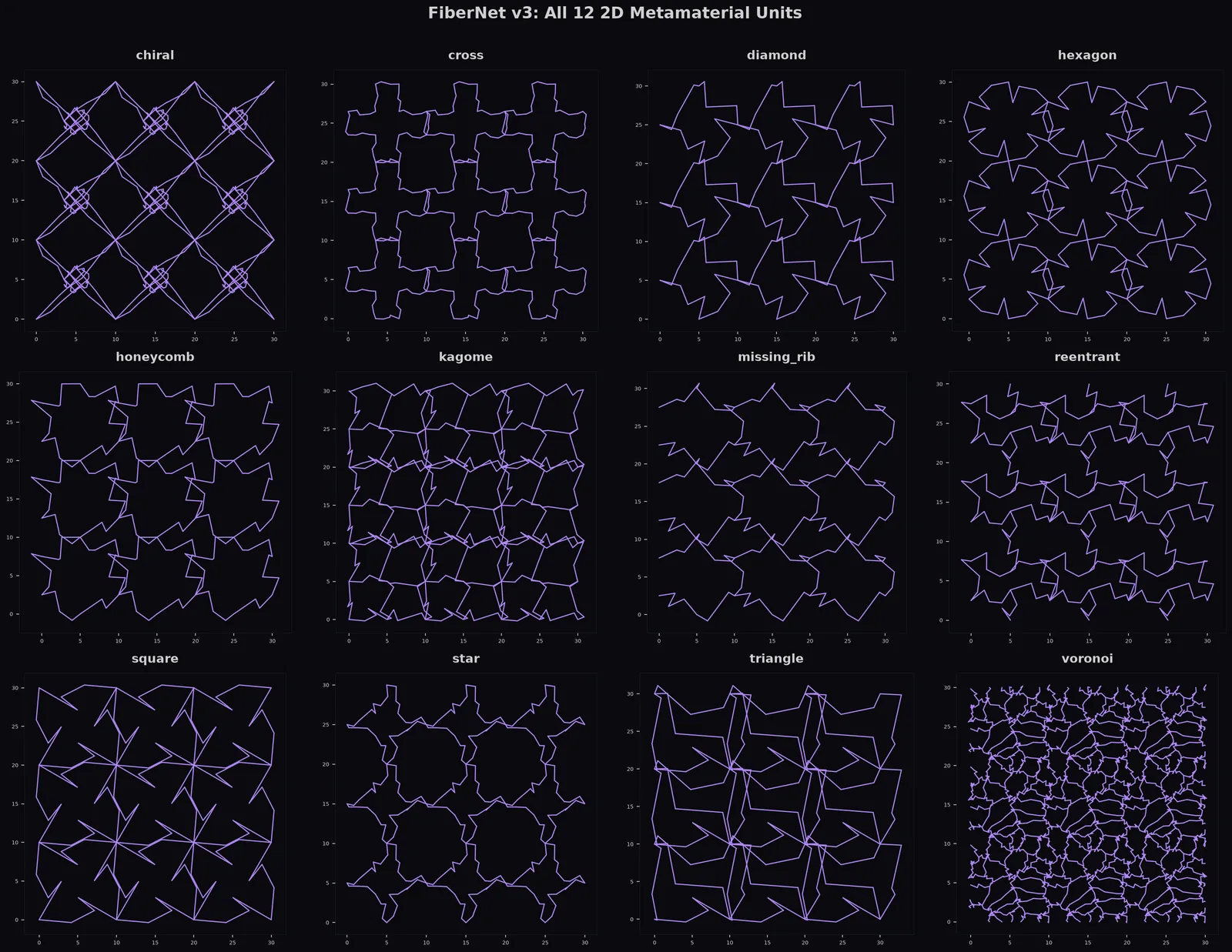
12 unit types across 6 architecture families / 12种基元,6大结构家族
Showcase / 展示
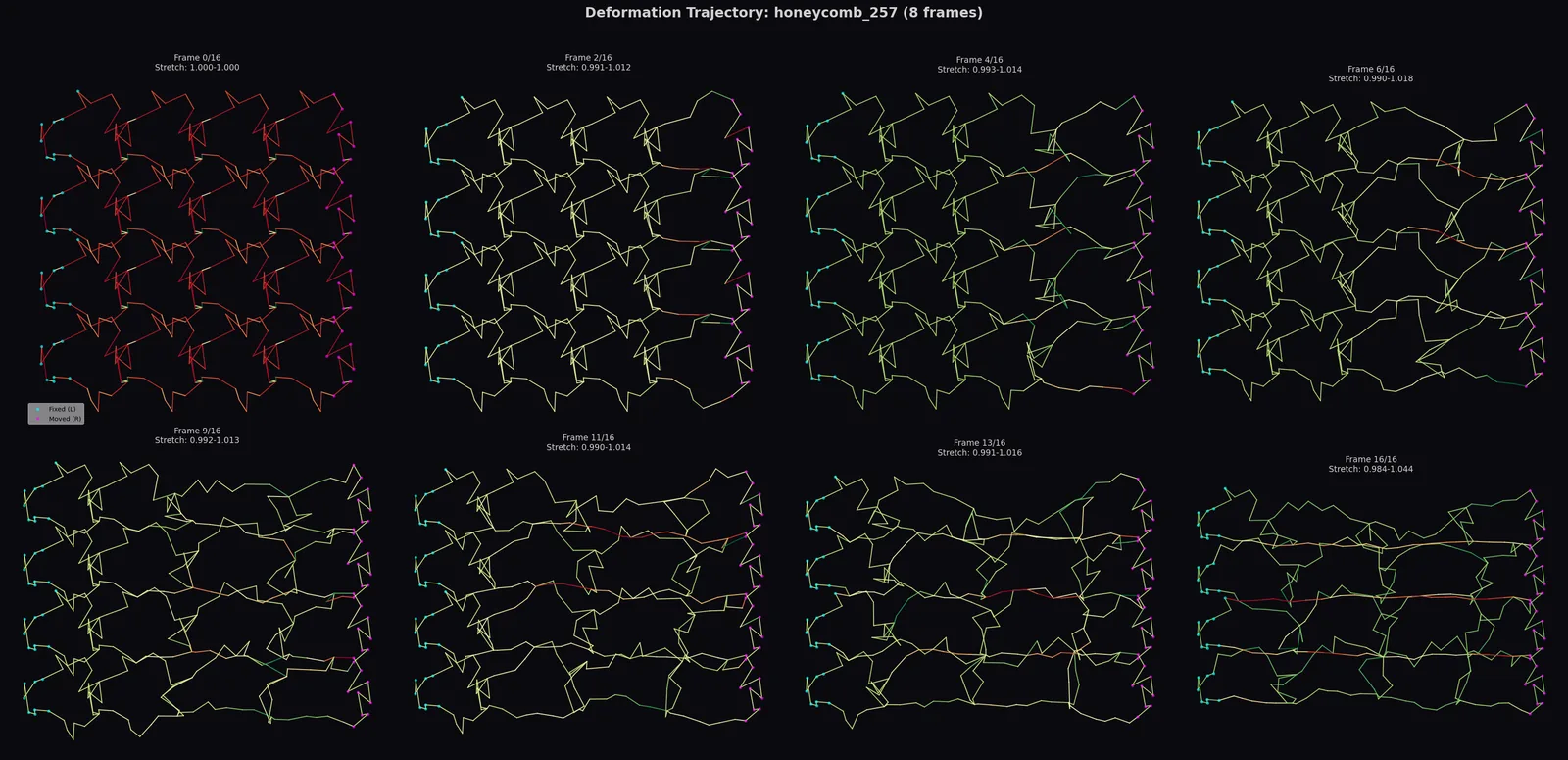
8-frame deformation trajectory: honeycomb under stretch, colored by edge stretch ratio / 蜂窝拉伸8帧形变轨迹
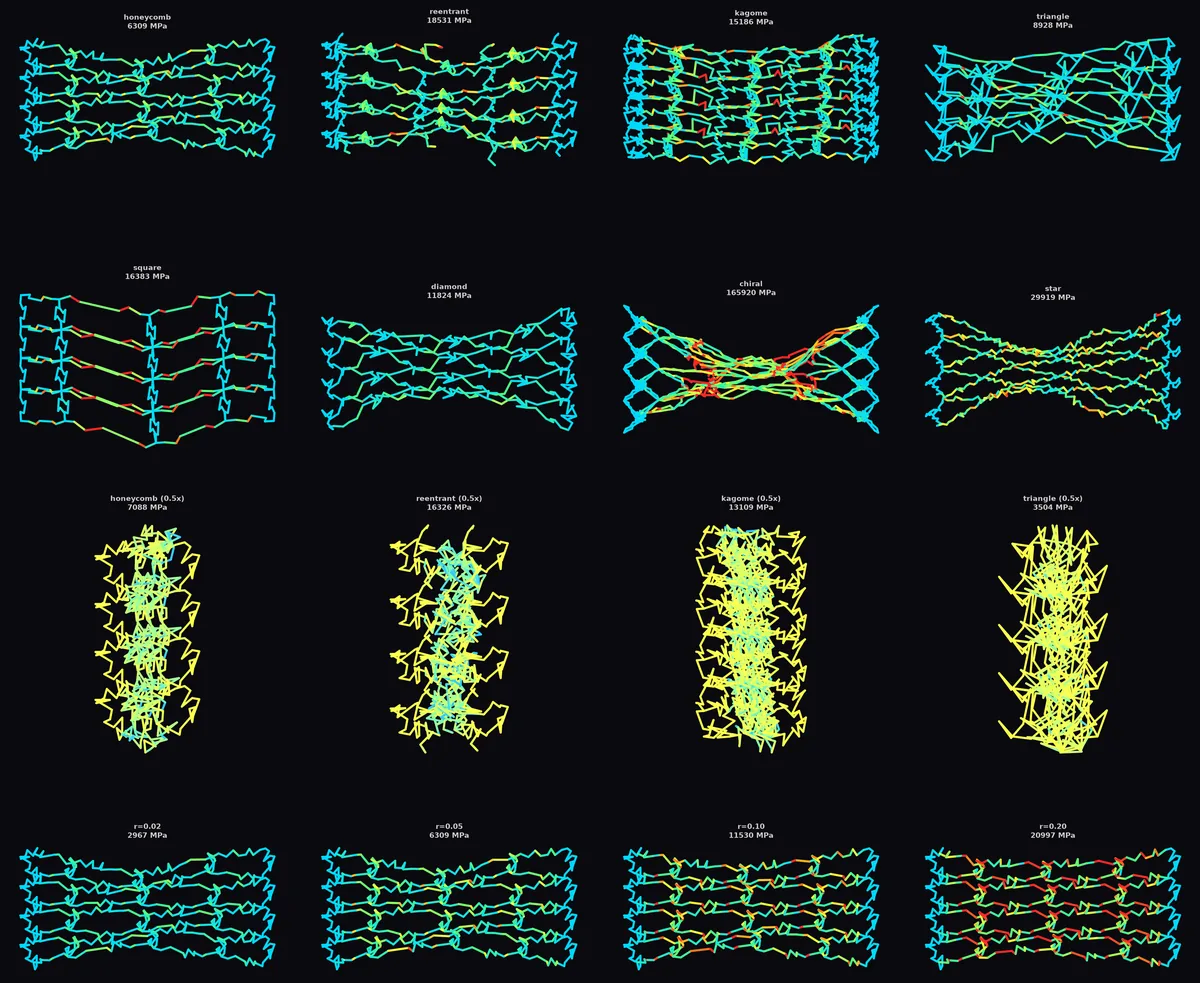
Beam Frame FEM: uniaxial stretch (2x) and compression (0.5x) across topologies and fiber radii. Bright color = high von Mises stress. Welded frames with radius-dependent bending stiffness. / Euler-Bernoulli梁框架FEM:拉伸(2倍)与压缩(0.5倍)模拟,亮色=高von Mises应力
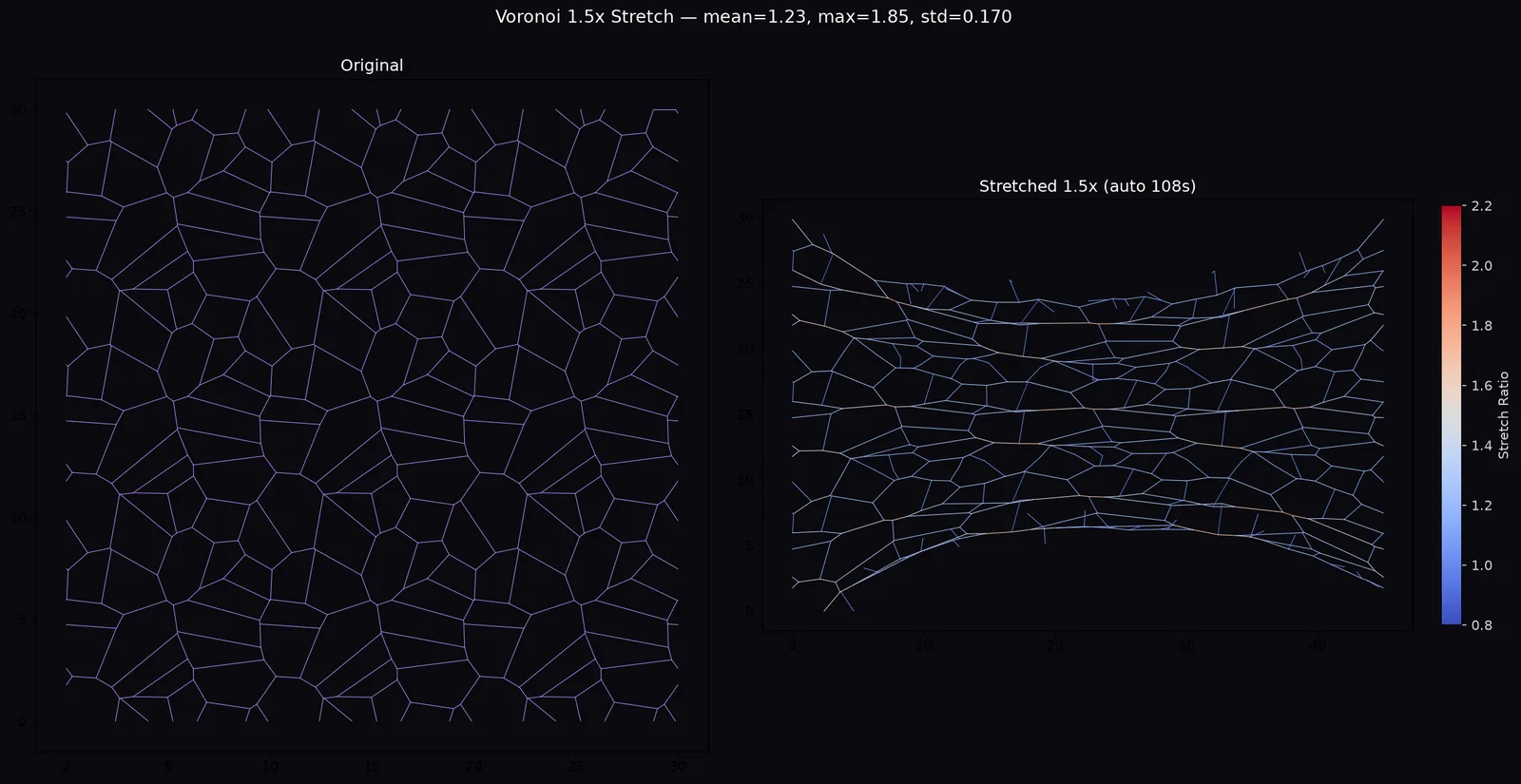
Voronoi structure under 1.5x uniaxial stretch — deformation and stress distribution / Voronoi 结构 1.5 倍单轴拉伸
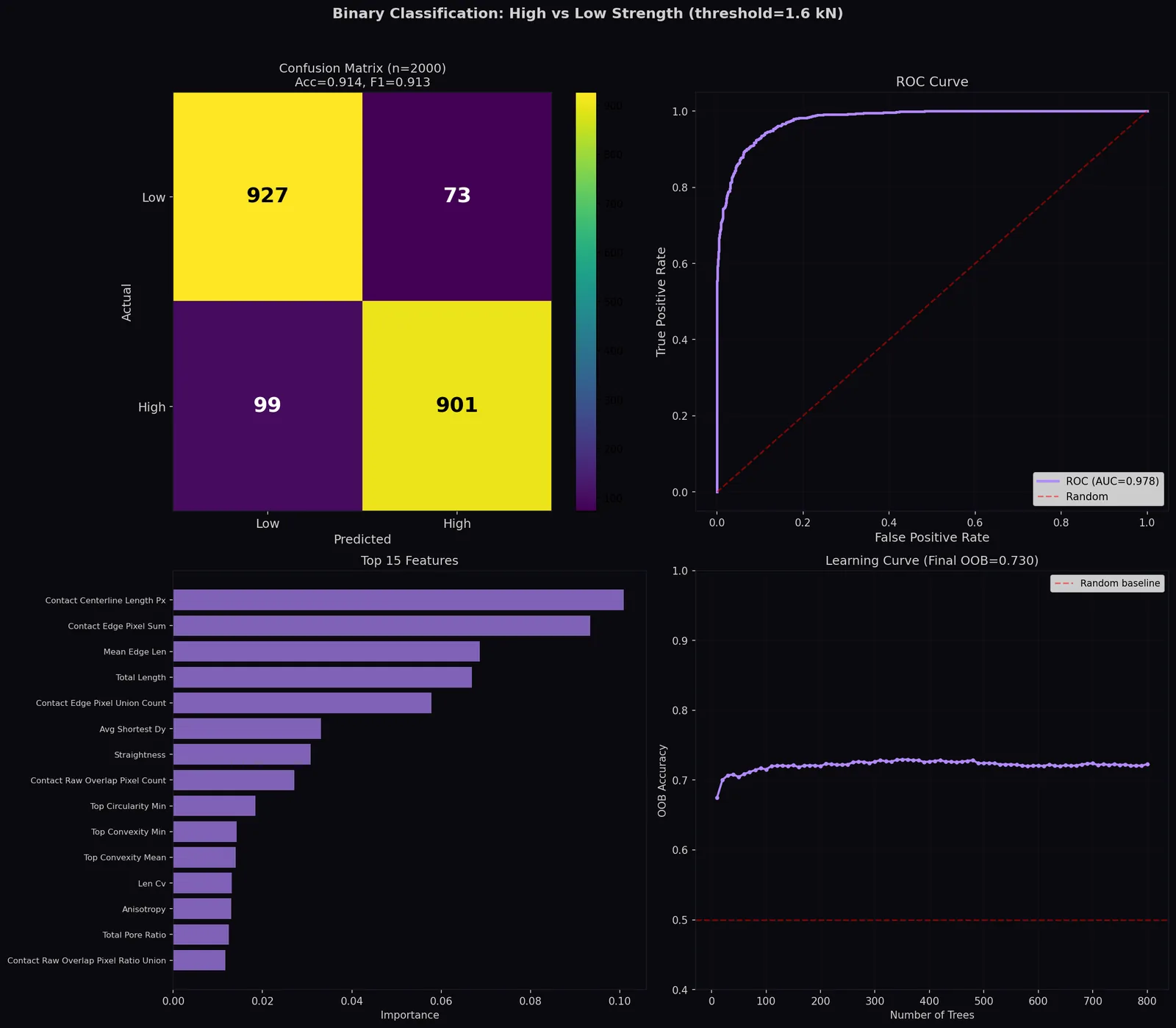
Machine learning analysis: confusion matrix, ROC curves, and learning curves / 机器学习分析面板
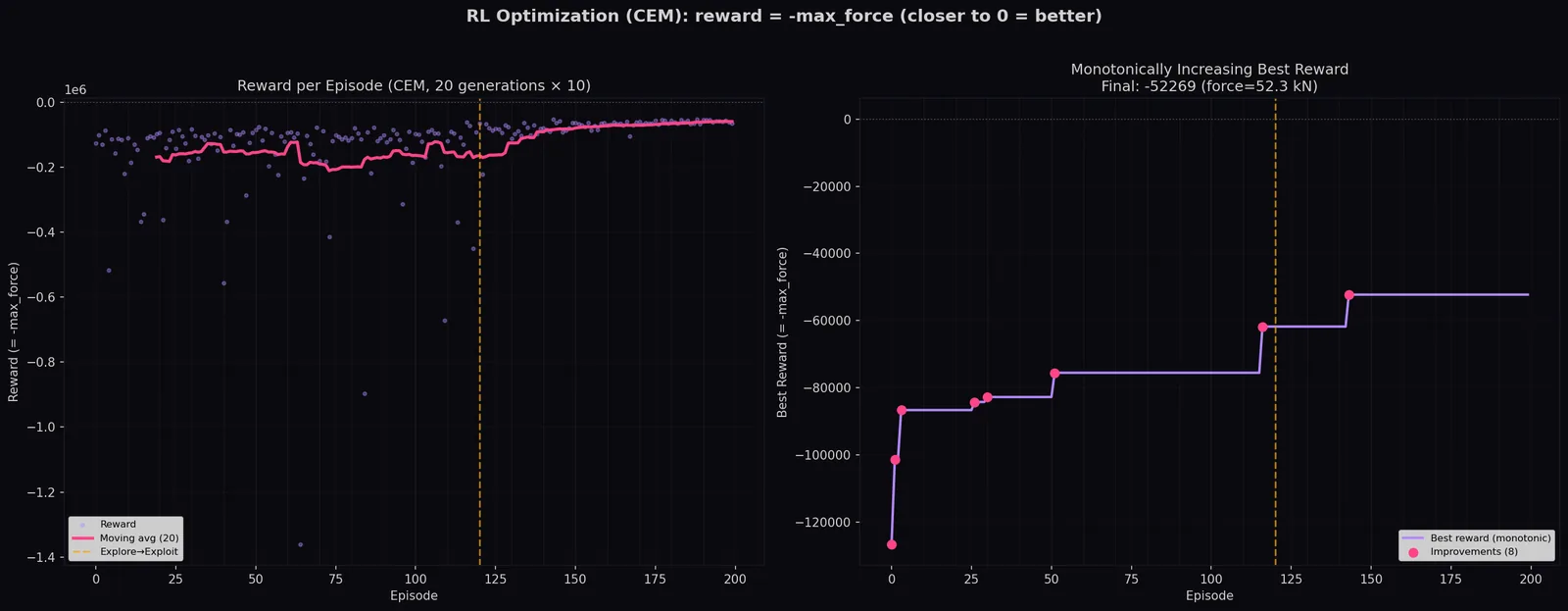
Reinforcement learning: reward per episode with monotonically increasing best reward / 强化学习训练曲线
One-Line API / 一行代码
import fibernet as fn

g = fn.pattern_2d(unit="honeycomb", grid=(4,4))
fn.show(g)
r = fn.simulate(g, mode="stretch", strain=1.5)
result = fn.predict_from_csv("data.csv", target="max_force")
best = fn.run_bayesian_optimization(obj, space, n_iter=50)
FEM in 3 Lines / 三行FEM
from fibernet.ml import BeamFrameFEM

solver = BeamFrameFEM(E=1e9, nu=0.3)
g = fn.pattern_2d(unit="honeycomb", box=(10, 10), grid=(4, 4), radius=0.05)
result = solver.stretch_test(g, target_stretch=2.0)

print(f"Max stress: {result['sigma_total'].max()/1e6:.1f} MPa")
print(f"Max displacement: {result['max_displacement']:.4f} m")
Euler-Bernoulli beam frame FEM with welded joints. Stretch and compression tests on any topology. / 欧拉-伯努利梁框架FEM,支持任意拓扑的拉伸与压缩测试。
Installation / 安装
pip install fibernet            # Core / 核心
pip install fibernet[full]      # ML + RL + Viz + Accel
pip install fibernet[ml]        # scikit-learn, pandas
pip install fibernet[rl]        # gymnasium, scikit-optimize
pip install fibernet[accel]     # taichi (GPU)
pip install fibernet[viz]       # pyvista (3D)
Platforms / 平台
| Ubuntu / macOS / Windows | Python 3.9 – 3.12 |
Machine Learning / 机器学习
Built-in feature extraction produces 94-dimensional structural descriptors. predict_from_csv() handles the full pipeline: train/test split, nested cross-validation, model comparison, and visualization — all in one call.
内置特征提取生成94维结构描述符,一行完成训练、交叉验证、模型对比与可视化。
Reinforcement Learning / 强化学习
Built-in optimization engines over a continuous parametric action space of internal node displacements. Automatically closes the loop: generate new structures, simulate their properties, evaluate the objective, and update parameters.
内置优化引擎在连续参数空间中自动搜索最优结构,闭环完成生成、模拟、评估、更新。
Complete Pipeline / 完整流水线
import fibernet as fn
import numpy as np

# 1. Parametric structure generation
displacements = [(np.random.uniform(-0.3,0.3), np.random.uniform(-0.3,0.3))
                 for _ in range(20)]
g = fn.pattern_2d(unit="square", grid=(3,3), n_pts_per_side=5,
                  point_displacements=displacements)

# 2. GPU-accelerated simulation with trajectory recording
engine = fn.TaichiEngine()
r = engine.stretch_test(g, target_stretch=1.5, stiffness=1e5, num_steps=5000)

# 3. Multi-frame stress visualization
fig = fn.render_trajectory(g, r.positions_trajectory, r.edge_stretches, n_frames=6)

# 4. Feature extraction (94-dim vector)
features = fn.GraphFeatureExtractor().extract(g)

# 5. Node manipulation for optimization
g.displace_node(g.get_internal_nodes()[0], [0.1, 0.2])
生成
模拟
机器学习
优化
Under active development. Full tutorial at tutorials/v4_tutorial/. 积极开发中。完整教程见 tutorials/v4_tutorial/。