Practical AFM Force Curve Analysis with Python
Contents / 目录
- Why This Guide Exists
- The Core Analysis Pipeline
- 1. Understanding AFM Force Curve Data
- 2. Loading Typical AFM Data Files
- 3. Converting Deflection to Force
- 4. Baseline Correction
- 5. Finding the Contact Point
- 6. Extracting Adhesion Force
- 7. Hertz Model Fitting for Young's Modulus
- Scaling and Advanced Topics
- 8. Batch Processing
- 9. Common Pitfalls
- 10. Alternative Models
- References
Why This Guide Exists
If you work with AFM force spectroscopy on soft biomaterials (collagen fibers, silk, hydrogels, cells), you have probably faced the same frustration: your instrument exports a pile of .txt or .csv files, and you spend hours manually processing them in proprietary software or Excel.
This guide gives you a complete, copy-paste-ready Python pipeline that handles everything from raw data loading to Young's modulus extraction. No commercial software required. Just numpy, scipy, and matplotlib.
The Core Analysis Pipeline
1. Understanding AFM Force Curve Data
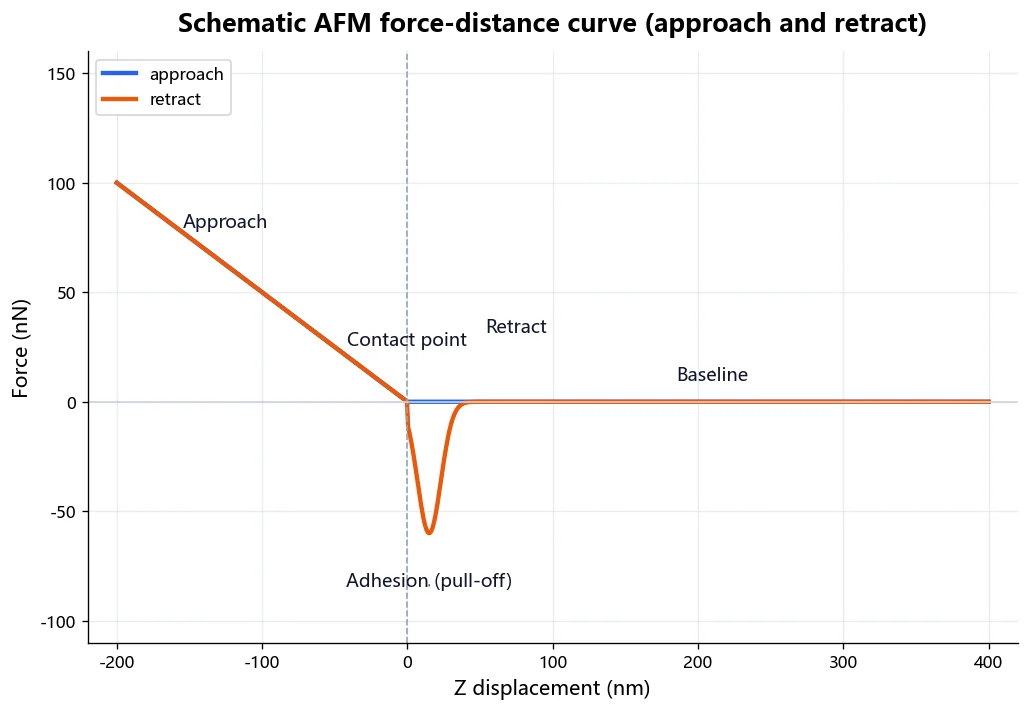
A typical AFM force curve records cantilever deflection (in volts or nanometers) as the piezo moves the tip toward and away from the sample:
| Segment | What happens | What you extract |
|---|---|---|
| --------- | ------------- | ----------------- |
| Approach | Tip approaches surface | Contact point, sample stiffness |
| Contact | Tip presses into sample | Elastic modulus (via fitting) |
| Retract | Tip pulls away | Adhesion force, unbinding events |
import numpy as np
import matplotlib.pyplot as plt
from scipy import signal, optimize
2. Loading Typical AFM Data Files
Most AFM instruments export tabular data. Common formats:
- Bruker/Veeco:
.txtwith header lines starting with\ - JPK/Nanowizard:
.txtor.jpk-forcewith metadata header - Asylum/AR:
.txtor.ibw(useigorpropackage) - Generic:
.csvwith columns: Z_piezo, Deflection
def load_afm_curve(filepath, skip_rows=0):
    data = np.loadtxt(filepath, skiprows=skip_rows)
    return data[:, 0], data[:, 1]

# Example: Bruker force curve
z_piezo, deflection = load_afm_curve("force_curve_001.txt", skip_rows=320)
Handling Bruker Headers
def load_bruker_curve(filepath):
    with open(filepath, "r") as f:
        lines = f.readlines()
    skip = 0
    for i, line in enumerate(lines):
        if line.strip().startswith("\\*") or "Ciao" in line:
            skip = i + 1
    data = np.loadtxt(filepath, skiprows=skip)
    return data[:, 0], data[:, 1]
3. Converting Deflection to Force
def deflection_to_force(deflection_V, spring_constant, sensitivity_nm_per_V):
    deflection_nm = deflection_V * sensitivity_nm_per_V
    force_N = spring_constant * deflection_nm * 1e-9
    return force_N * 1e9  # nN

k = 0.06        # N/m (Bruker MLCT)
sensitivity = 45.0  # nm/V
force = deflection_to_force(deflection, k, sensitivity)
4. Baseline Correction
def baseline_correct(z_piezo, force, contact_idx):
    baseline_region = slice(0, contact_idx)
    coeffs = np.polyfit(z_piezo[baseline_region], force[baseline_region], 1)
    baseline = np.polyval(coeffs, z_piezo)
    return force - baseline
5. Finding the Contact Point
def find_contact_point(z_piezo, force, window=50, threshold_factor=5):
    force_smooth = signal.savgol_filter(force, window_length=21, polyorder=3)
    dz = np.gradient(z_piezo)
    df = np.gradient(force_smooth)
    derivative = df / dz
    noise_region = slice(0, len(force) // 5)
    noise_std = np.std(derivative[noise_region])
    threshold = threshold_factor * noise_std
    above_threshold = np.abs(derivative) > threshold
    for i in range(len(above_threshold) - window):
        if np.all(above_threshold[i:i + window]):
            return i + window // 2
    return len(force) // 2
6. Extracting Adhesion Force
def extract_adhesion(z_piezo, force, contact_idx):
    retract_region = force[contact_idx:]
    adhesion_idx = np.argmin(retract_region)
    adhesion_force = retract_region[adhesion_idx]
    return adhesion_force if adhesion_force < 0 else 0.0
7. Hertz Model Fitting for Young's Modulus
For a spherical indenter on a flat elastic half-space:
F = (4/3) E* sqrt(R) delta^(3/2)
where E* = E / (1 - nu^2).
def hertz_sphere(indentation, E_star, R):
    return (4/3) * E_star * np.sqrt(R) * np.power(np.maximum(indentation, 0), 1.5)

def fit_youngs_modulus(z_piezo, force, contact_idx, tip_radius_nm=20.0,
                        poisson=0.5, fit_range_nm=50.0):
    indent = z_piezo[contact_idx] - z_piezo
    contact_force = force - force[contact_idx]
    fit_mask = (indent > 0) & (indent < fit_range_nm) & (contact_force > 0)
    indent_fit = indent[fit_mask]
    force_fit = contact_force[fit_mask]
    if len(indent_fit) < 50:
        return np.nan, np.nan
    def model(delta, E_star):
        return hertz_sphere(delta, E_star, tip_radius_nm)
    popt, pcov = optimize.curve_fit(model, indent_fit, force_fit,
        p0=[1000], bounds=(1, 1e9))
    E_star = popt[0]
    E = E_star * (1 - poisson**2)
    E_std = np.sqrt(pcov[0, 0]) * (1 - poisson**2)
    return E, E_std
Scaling and Advanced Topics
8. Batch Processing
import glob
from pathlib import Path

def batch_process_curves(data_dir, k=0.06, sensitivity=45.0):
    results = []
    for filepath in sorted(glob.glob(f"{data_dir}/*.txt")):
        try:
            z, deflection = load_afm_curve(filepath, skip_rows=320)
            force = deflection_to_force(deflection, k, sensitivity)
            cidx = find_contact_point(z, force)
            force_corr = baseline_correct(z, force, cidx)
            adhesion = extract_adhesion(z, force_corr, cidx)
            E, _ = fit_youngs_modulus(z, force_corr, cidx)
            results.append({"file": Path(filepath).name,
                "adhesion_nN": adhesion, "E_Pa": E})
        except Exception as e:
            print(f"Failed: {filepath}: {e}")
    return results
9. Common Pitfalls
| Problem | Likely Cause | Fix |
|---|---|---|
| --------- | ------------- | ----- |
| Contact point too early | Baseline noise | Increase threshold_factor |
| Negative modulus | Wrong direction | Check z_piezo sign convention |
| Substrate effect | Too deep indentation | fit_range_nm < 10% of thickness |
| Zero adhesion | No retract data | Enable retract in AFM method |
10. Alternative Models
- Sneddon model: for conical indenters: F = (2/pi) E* tan(alpha) delta^2
- JKR model: includes adhesion in contact mechanics
- Ting's model: for viscoelastic relaxation
def sneddon_cone(indentation, E_star, alpha_deg=18):
    alpha = np.radians(alpha_deg)
    return (2 / np.pi) * E_star * np.tan(alpha) * np.power(indentation, 2)
References
- Cappella, B. & Dietler, G. (1999). Force-distance curves by AFM. Surface Science Reports, 34(1-3), 1-104.
- Hertz, H. (1882). On the contact of elastic solids. J. Reine Angew. Math., 92, 156-171.
- Sneddon, I.N. (1965). The relation between load and penetration. Int. J. Eng. Sci., 3(1), 47-57.
- JPK Instruments. A Practical Guide to AFM Force Spectroscopy.